Florida medical practices need to pay close attention to how patient overpayments and credit balances are handled under the state’s updated healthcare billing requirements. SB 1808 establishes a 30-day refund requirement after a covered provider or licensee determines that a patient overpayment has occurred, making timely account review and refund processing an important part of medical billing compliance.
For clinic managers, practice administrators, and healthcare providers, this means patient credit balances can no longer be treated as routine accounting items that remain unresolved without a defined process. A credit balance may result from duplicate payments, insurance adjustments, incorrect patient responsibility amounts, or other billing circumstances.
The challenge is not simply identifying the balance; it is determining whether it represents an actual patient overpayment, documenting when that determination was made, and ensuring the appropriate refund is processed within the applicable timeframe. Practices that rely on multiple billing staff, management companies, or outsourced medical billing providers also need clear accountability for each step.
What Is Florida SB 1808?
Florida Senate Bill 1808, formally titled the Refund of Overpayments Made by Patients, created new requirements for certain Florida health care practitioners and health care facility licensees concerning patient overpayments. The law requires covered providers to refund qualifying patient overpayments within 30 days after the provider determines that an overpayment was made. The legislation took effect on January 1, 2026.
For medical practices, the practical issue is not simply identifying a credit balance. The practice needs to determine whether the credit represents an actual patient overpayment, document when that determination was made, and have a process for completing the refund within the applicable timeframe.
When Did Florida SB 1808 Take Effect?
Florida SB 1808 took effect on January 1, 2026. The enacted legislation created Florida Statutes §§408.12 and 456.0625, establishing patient-overpayment refund requirements for covered licensees and health care practitioners.
This means medical practices subject to the applicable provisions should have their patient credit-balance and refund processes aligned with the requirements that became effective at the beginning of 2026.
What Does SB 1808 Require?
The central requirement is straightforward: a covered provider or practitioner must refund a qualifying patient overpayment no later than 30 days after determining that the overpayment was made.
Importantly, the statute ties the 30-day period to the date the overpayment is determined, rather than simply the date a payment was originally received. That distinction makes accurate account review and documentation an important part of the billing process.
Who Does the Law Apply To?
The law contains provisions covering health care practitioners and certain health care facility licensees. Under §456.0625, the requirement also expressly addresses a billing department, management company, or group practice that accepts payment for services rendered by the health care practitioner.
For AHCA-regulated licensees covered by §408.12, a licensee that tenders charges for reimbursement must refund qualifying patient overpayments within the 30-day period.
This makes it important for medical practices to understand exactly which entity is responsible for reviewing patient accounts, determining overpayments, and processing refunds.
Florida SB 1808 Medical Billing Requirements
Florida SB 1808 makes patient overpayment management an important part of medical billing compliance. The statute establishes a specific refund timeframe, while the day-to-day work of identifying, reviewing, documenting, and processing those refunds generally happens through the practice’s billing and revenue cycle operations.
The 30-Day Patient Overpayment Refund Requirement
The 30-day period begins after the covered provider or practitioner determines that an overpayment was made. Both §408.12 and §456.0625 use this determination date as the point from which the refund period runs.
For this reason, practices should avoid treating every account credit as an automatically confirmed overpayment. A credit balance may require additional review of insurance payments, contractual adjustments, patient responsibility, previous transactions, and other account information.
Once the practice determines that a qualifying patient overpayment exists, however, the determination date becomes an important compliance record because it establishes the starting point for the 30-day refund period.
What Counts as a Patient Overpayment?
A patient overpayment generally occurs when a patient has paid more than the amount ultimately owed for covered services. Common examples may include:
- Duplicate patient payments
- Incorrect patient responsibility amounts
- Payments exceeding the patient’s final balance
- Credit balances remaining after insurance adjudication
- Other situations in which the patient has paid more than the amount owed
A credit balance should still be reviewed before being classified as a patient overpayment. For example, an account may show a credit while an insurance claim is still being corrected or an adjustment has not yet been properly posted.
It is also important to distinguish patient overpayments from overpayments that an insurer, HMO, or government program seeks to recover from a provider. Those situations can be governed by different statutory or program requirements.
Exceptions and Other Overpayment Rules
SB 1808 does not apply to an overpayment subject to Florida Statutes §§627.6131 or 641.3155. The statute expressly excludes those categories from the patient-overpayment provisions.
This distinction matters because a medical practice may encounter several types of account discrepancies. A patient refund, an insurer’s provider-overpayment claim, and a Medicaid overpayment should not automatically be placed into the same workflow.
For example, Florida law contains separate procedures for certain insurer and HMO overpayment claims involving providers.
Patient Credit Balance Management Under Florida Law
Patient credit balances can develop for many reasons, but identifying a credit is only the first step. A practice needs a consistent process for determining what caused the credit and whether it represents money that should be returned to the patient.
Why Patient Credit Balances Need a Formal Workflow
A formal credit-balance workflow can help a medical practice consistently handle:
- Identifying credit balances
- Determining whether the credit is a true overpayment
- Reviewing insurance payments and adjustments
- Confirming the patient’s responsibility
- Documenting the determination
- Initiating the refund
- Tracking completion
Without a defined process, credit balances can remain unresolved while staff members assume that another department or billing vendor is handling them.
Create a Patient Credit Balance Review Process
A straightforward internal workflow can look like this:
Credit balance identified → Account reviewed → Overpayment confirmed → Determination date documented → Refund initiated → Refund completed → Records retained
The exact workflow can vary by practice size and billing system, but each stage should have a clearly assigned responsibility.
Maintain an Overpayment Refund Log
A refund log can provide a centralized record of qualifying patient overpayments and the actions taken on each account.
| Field | Purpose |
| Patient/account ID | Identify the account |
| Date credit balance identified | Establish an audit trail |
| Date overpayment determined | Track the beginning of the 30-day period |
| Overpayment amount | Record the amount to be refunded |
| Reason for overpayment | Document the underlying issue |
| Refund date | Demonstrate when the refund was processed |
| Refund method | Track how the payment was returned |
| Staff/member responsible | Establish accountability |
| Supporting documentation | Maintain the relevant account records |
The key distinction is between the date a credit is identified and the date an actual overpayment is determined. Practices should document both when they are different.
Florida Healthcare Compliance Checklist for Clinic Managers
A practical compliance review can help clinic managers determine whether patient credit balances are being handled consistently. The following checklist can be incorporated into an internal billing review.

1. Identify Patient Credit Balances
- Review outstanding credit balances regularly.
- Separate legitimate credits from unresolved billing issues.
- Flag potential patient overpayments for review.
2. Determine Whether an Overpayment Exists
Review the complete account before classifying a credit as an overpayment. This may include:
- Account history
- Insurance adjudication
- Contractual adjustments
- Patient payments
- Current patient responsibility
- Previous refunds or adjustments
The goal is to establish whether the patient actually paid more than was owed.
3. Document the Determination Date
The determination date deserves particular attention because the 30-day refund requirement is tied to the date the covered provider or practitioner determines that an overpayment was made.
Staff should therefore have a consistent method for recording this date in the billing system or compliance records.
4. Start the 30-Day Refund Tracking Period
Once a qualifying patient overpayment has been determined, record the applicable deadline and track the refund through completion.
An automated billing-system task, spreadsheet, refund queue, or dedicated compliance report can help prevent confirmed overpayments from remaining unresolved.
5. Process the Patient Refund
Document the key details of the transaction, including:
- Refund amount
- Refund date
- Refund method
- Supporting account records
The practice should be able to connect the refund to the underlying patient account and the determination that resulted in the refund.
6. Escalate Unresolved Accounts
Create an escalation process for accounts involving:
- Unclear ownership
- Missing documentation
- Patient contact problems
- Disputed balances
- Complex insurance situations
Escalation procedures are particularly useful when a credit balance cannot be resolved through the normal billing workflow.
7. Audit the Process Periodically
Periodic internal reviews can help determine whether the practice is consistently identifying patient overpayments, documenting determination dates, processing refunds, and retaining supporting records.
What Happens If a Florida Medical Practice Fails to Refund an Overpayment?
The consequences depend on which statutory provision applies to the entity involved. The law establishes different consequences for covered AHCA-regulated licensees and health care practitioners.
AHCA Administrative Penalties for Covered Licensees
Under §408.12, a covered licensee that fails to refund a patient overpayment is subject to an administrative fine under §408.813.
The enacted legislation identifies failure to refund a patient overpayment under §408.12 as an unclassified violation. Under the applicable provision, an unclassified violation generally carries a maximum fine of $500 per violation, unless otherwise specified by law.
Disciplinary Consequences for Health Care Practitioners
For practitioners covered by §456.0625, violating the patient-overpayment refund requirement constitutes grounds for disciplinary action under §456.072.
This is why practices should not treat patient refunds as merely an accounting issue. The applicable statutory requirements can also have professional or administrative compliance implications.
Why Documentation Matters
Documentation provides evidence of how the practice handled an account.
No documentation → difficult to establish when the overpayment was determined → difficult to demonstrate timely compliance.
Maintaining determination dates, refund records, account histories, and supporting documentation can therefore help create a clear record of the practice’s billing process.
Does Outsourcing Medical Billing Remove the Practice’s Responsibility?
Outsourcing billing can change who performs day-to-day billing activities, but practices should still establish clear responsibilities for patient credit balances and refunds.
The Role of Third-Party Medical Billing Companies
An outsourced billing company may be involved in:
- Account reconciliation
- Credit balance reviews
- Patient refunds
- Billing adjustments
- Documentation
- Revenue cycle reporting
Because the billing company may have direct access to patient accounts, the practice should establish clear procedures for communicating and resolving qualifying overpayments.
Establish Clear Accountability Between the Practice and Billing Company
The practice and billing company should clearly define:
- Who reviews credit balances?
- Who determines whether an overpayment exists?
- Who records the determination date?
- Who approves refunds?
- Who sends the refund?
- Who maintains documentation?
- Who performs compliance audits?
Florida’s practitioner provision specifically includes a billing department, management company, or group practice that accepts payment for services rendered by the practitioner.
That makes it especially important to avoid vague contractual arrangements where both the practice and billing vendor assume the other party is responsible.
Add Refund Requirements to Your Billing Vendor Agreement
Medical practices using outside billing support can consider documenting:
- Refund-processing responsibilities
- Reporting requirements
- Turnaround expectations
- Documentation standards
- Audit rights
- Escalation procedures
Clear contractual responsibilities can make it easier to identify who handles each stage of the refund workflow.
Florida Medical Billing Regulations: Patient Overpayments vs. Insurance Overpayments
Not every credit or overpayment encountered by a medical practice should be handled as a patient refund. The source of the overpayment matters.
Patient Overpayments
SB 1808’s patient-overpayment provisions require covered practitioners and licensees to refund qualifying patient overpayments within 30 days after determining that the overpayment was made.
This is the workflow most directly relevant to patient credit balances.
Insurance or HMO Overpayment Claims
Insurance and HMO overpayment claims can operate under separate Florida statutory requirements. For example, §641.3155 establishes procedures for HMO claims seeking recovery of provider overpayments, including specific response and dispute timelines.
These are provider-payer transactions rather than ordinary patient refunds and should therefore be handled through the appropriate payer-overpayment process.
Why Clinic Managers Should Not Treat Every Credit Balance the Same
A practical classification system can help:
Patient credit → patient overpayment review
Insurance/HMO overpayment → payer overpayment workflow
Medicaid overpayment → Medicaid compliance/self-audit workflow
Florida Medicaid guidance explains that when a provider determines it has received an improper Medicaid reimbursement, the provider has an obligation to return the improper amount to the state, with supporting information to validate the overpayment.
Separating these workflows helps prevent staff from treating every credit balance as though it were subject to the same refund rules.
How to Build an SB 1808 Compliance Workflow for Your Medical Practice
Implementing a consistent workflow can make patient overpayment management easier to monitor and document.
Step 1: Assign Responsibility
Identify the person or team responsible for reviewing patient credit balances and coordinating refunds.
Responsibility may sit with the billing department, revenue cycle team, practice administrator, or another designated employee depending on the practice structure.
Step 2: Establish a Review Frequency
Practices can establish a review schedule appropriate to their billing volume and internal controls, such as:
- Weekly
- Biweekly
- Monthly
The statute establishes the refund requirement but does not prescribe one universal credit-balance review frequency. The appropriate internal schedule should therefore reflect the practice’s operations and risk controls.
Step 3: Create a Refund Tracking System
Track each confirmed patient overpayment from determination through refund completion.
At minimum, the system should make it easy to identify the determination date, amount, status, refund date, and responsible staff member.
Step 4: Create an Escalation Policy
Define what happens when an account cannot be resolved promptly.
For example, accounts involving disputed insurance payments, unclear balances, missing records, or patient-contact issues can be escalated to a designated billing manager or compliance contact.
Step 5: Perform Periodic Internal Audits
Sample both open and closed credit-balance accounts to review:
- Determination dates
- Refund dates
- Documentation
- Escalations
- Outstanding balances
The purpose is to identify process weaknesses before they become recurring problems.
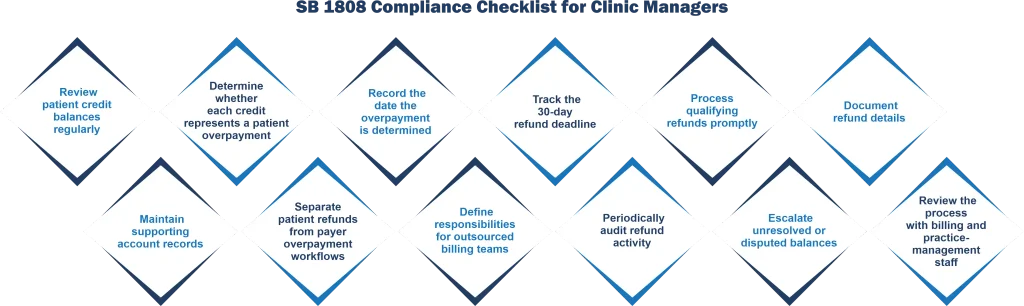
SB 1808 Compliance Checklist for Clinic Managers
Use this checklist as a practical internal review tool:
☐ Review patient credit balances regularly
☐ Determine whether each credit represents a patient overpayment
☐ Record the date the overpayment is determined
☐ Track the 30-day refund deadline
☐ Process qualifying refunds promptly
☐ Document refund details
☐ Maintain supporting account records
☐ Separate patient refunds from payer overpayment workflows
☐ Define responsibilities for outsourced billing teams
☐ Periodically audit refund activity
☐ Escalate unresolved or disputed balances
☐ Review the process with billing and practice-management staff
How Medical Practices Can Stay Ready for Florida Billing Compliance Reviews
A well-organized billing process can make it easier for a medical practice to demonstrate how patient credit balances and refunds are handled.
Maintain consistent documentation for credit-balance reviews, overpayment determinations, and completed refunds. Practices can also retain credit-balance reports, refund logs, written policies, staff training records, vendor oversight documentation, and internal audit results as appropriate to their operations.
Clear responsibility assignments are equally important. Staff should know who reviews credit balances, who determines whether an overpayment exists, who processes the refund, and who handles escalated accounts.
The goal is to create a documented process that allows the practice to show how an account moved from an identified credit balance to a confirmed overpayment and, where applicable, a completed patient refund.
Simplifying Florida Medical Billing Compliance With the Right Support
Managing patient credit balances, insurance payments, billing adjustments, and refund workflows can become difficult for busy medical practices. A structured billing process can help clinics maintain accurate patient accounts and improve oversight of billing operations.
If your practice needs additional support with day-to-day billing and revenue cycle processes, explore our Florida Medical Billing Services to learn how professional billing support can fit into your practice workflow.
Summary
Florida SB 1808 is now part of the state’s patient-overpayment compliance framework, with the relevant provisions taking effect on January 1, 2026. Covered practitioners and licensees need a process for identifying qualifying patient overpayments and completing refunds within the applicable 30-day period after determining that an overpayment was made.
For clinic managers, the most important operational steps are identifying credit balances, reviewing whether they represent actual patient overpayments, documenting the determination date, tracking the refund deadline, and retaining supporting records.
Practices should also distinguish patient overpayments from insurance, HMO, and Medicaid overpayment situations because those categories can involve separate requirements and workflows.