
Do claim rejections continue to slow down your reimbursements and disrupt your cash flow? Even minor administrative mistakes can prevent a claim from being accepted on the first submission, leading to payment delays, additional staff workload, and unnecessary revenue loss. Many first-pass claim rejections are preventable through accurate patient information, proper coding, and compliance with payer-specific billing requirements.
Clean claims are processed much faster than corrected claims, making first-pass acceptance one of the most important performance indicators in revenue cycle management. By strengthening front-end workflows, verifying insurance eligibility, and reviewing claims before submission, healthcare practices can significantly improve reimbursement speed while reducing administrative costs.
This guide explains practical strategies to reduce claim rejections on the first submission. You’ll learn how to improve patient verification, coding accuracy, claim review processes, staff training, and payer compliance to increase your first-pass acceptance rate.
Verify Patient Information Accurately
Administrative errors at the front desk account for roughly 40% of all first-pass claim rejections. Ensuring absolute accuracy during the initial patient intake phase is the fastest way to eliminate downstream billing friction and prevent revenue leakage.
The front-office intake workflow must function as a strict, chronological checklist before clinical care is delivered:
Confirm Eligibility Before Service: Streamline intake workflows by utilizing professional medical front office management services to verify coverage boundaries before care is delivered. This proactive step allows staff to confirm active coverage, map out copays or deductibles, and flag whether specific procedural codes require prior authorization from the payer.
Collect Complete Patient Details: Capture the patient’s full legal name exactly as it appears on their insurance card—this is non-negotiable. Billers must verify the exact spelling, date of birth, gender, and current residential address, updating the practice management system immediately whenever demographic changes occur.
Verify Insurance Information: Securely scan both sides of the patient’s active insurance card. Front-office staff must validate the member ID, locate the group number, and evaluate coordination of benefits (COB) rules to accurately determine primary versus secondary payer responsibilities.
Use Correct Coding Every Time
Coding inaccuracies represent nearly 30% of all administrative claim rejections. Transforming complex clinical documentation into clean claims requires precise code selection and strict adherence to regular regulatory updates.
Apply Modifiers Correctly: Modifiers provide essential clinical context to insurance clearinghouses. Whether utilizing Modifier 25 to denote a significant, separately identifiable evaluation and management (E/M) service, or Modifier 59 to signal a distinct procedural service, missing or misapplied modifiers trigger immediate automated system rejections.
Select Appropriate CPT Codes: Clinical coders must select the most specific Current Procedural Terminology (CPT) code that accurately reflects the documented care. This process includes cross-checking payer-specific bundling guidelines and National Correct Coding Initiative (NCCI) edits to avoid unbundling errors or utilizing outdated, invalid codes.
Link Diagnosis Codes Properly: Every billed service must demonstrate clear medical necessity. The primary ICD-10-CM code must directly justify the primary CPT code used, avoiding generic or unspecified codes whenever highly detailed, granular diagnosis options are available in the medical chart.
Submit Clean Claims First Time
A clean claim contains entirely complete, validated, and compliant information. Implementing robust pre-submission review protocols acts as a critical line of defense against predictable billing rejections.
Use Claim Scrubbing Software
Automated software flags common structural errors before submission. Modern platforms scan for missing or invalid codes, verify that patient and provider demographic fields are completely filled out, and automatically catch duplicate claims before they leave the practice. Implementing these real-time edits can reduce front-end claim rejections by up to 70%.
Review Claims Before Submission
While automated scrubbing filters excel at catching structural formatting errors, a manual review process safeguards against nuanced discrepancies, such as mismatched units of service or incorrect place-of-service (POS) codes.
Once a clean claim is successfully processed and paid, integrating your ledger with specialized payment posting services allows the practice to accurately reconcile insurance payments, contractual adjustments, and remaining patient balances while monitoring your ongoing first-pass acceptance rates.
Submit Electronically When Possible
Electronic claims process weeks faster than traditional paper documentation. Clearinghouses validate claims against basic structural rules before they ever reach the payer’s system, leveraging real-time edits to catch transmission errors instantly. This digital pipeline allows billing teams to track claim status online and rapidly resubmit corrections when needed.
Follow Payer-Specific Requirements
Each insurance carrier maintains independent, highly specific claim submission rules. Understanding and adapting to these unique payer guidelines prevents administrative rejections before they disrupt cash flow.
Know Payer Guidelines
While Medicare requires strict adherence to federal documentation criteria, Medicaid frameworks vary heavily by state, and commercial payers maintain their own distinct billing structures.
However, even the most accurate claim will face immediate rejection if the provider’s credentialing data is not properly loaded into the insurance network. Utilizing professional medical credentialing services ensures that your provider’s NPI, taxonomy codes, and commercial payer enrollments are perfectly aligned within the insurance database to completely stop avoidable network eligibility rejections.
Meet Documentation Requirements
Failing to attach required clinical documentation will cause claims to be rejected or denied immediately. Ensure your submission workflows systematically include:
Prior authorization forms when mandated by specific payer policies.
Referral forms for specialist visits and out-of-network consultations.
Detailed medical records, such as operative reports for complex surgical procedures or specific lab results, to support the level of service billed.
Use Correct Claim Forms
Billing teams must ensure the electronic format and physical document layout match payer specifications exactly. Professional services must always be billed using the CMS-1500 form, while facility and hospital services require the UB-04 form. Submitting your data on outdated form versions triggers automatic system rejections.
Summary of Rejection Drivers & Interventions
| Primary Rejection Cause | Revenue Impact % | Core Prevention Strategy |
| Front-Desk Intake Errors | ~40% of rejections | Front-office eligibility checks & card scanning |
| Coding Inaccuracies | ~30% of rejections | Precise CPT/ICD-10 linking & NCCI edit reviews |
| Documentation & Authorizations | ~20% of rejections | Pre-submission audits & mandatory authorization tracking |
| Other Technical Errors | ~10% of rejections | Automated claim scrubbing & electronic clearinghouses |
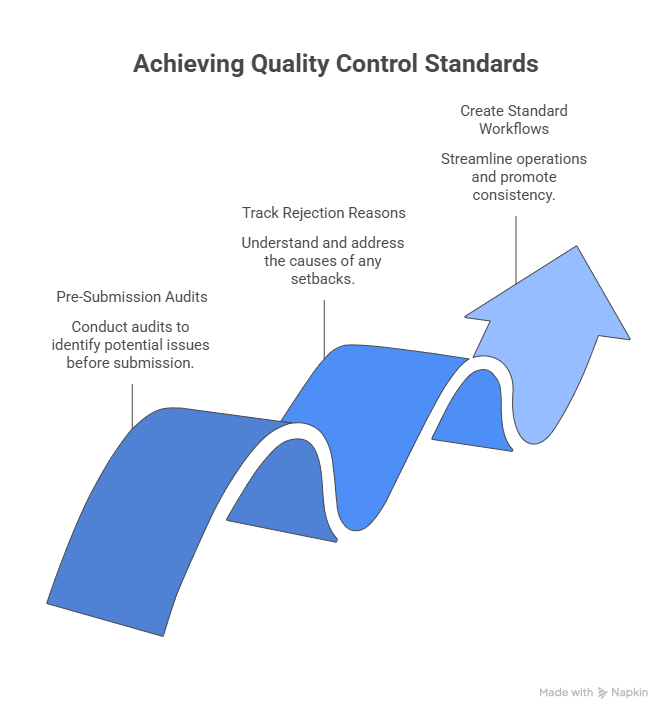
Implement Quality Control Processes
Quality checks catch errors before claim submission. Regular audits identify problem areas needing attention.
Conduct Pre-Submission Audits
Review a random sample of claims daily. Check for common error patterns found. Verify coding accuracy before sending claims. Confirm all required fields are completed properly. Ensure docs support services are billed correctly. Fix errors before submitting to the payer. Daily audits prevent recurring rejection problems.
Track Rejection Reasons
Monitor rejection reasons by type monthly. Identify the most common rejection causes quickly. Track patterns by staff member or payer. Set goals to reduce the top rejection reasons. Share findings with billing staff regularly. Implement fixes for recurring problems found. Data tracking drives continuous improvement efforts.
Create Standard Workflows
Document step-by-step claim submission procedures clearly. Assign specific tasks to trained staff. Create checklists for claim preparation steps. Set up review points before submission. Define who approves claims before sending. Standardize processes across all staff members.
Train Staff on Best Practices
Well-trained staff make fewer claim submission errors. Regular education keeps the team updated on changes.
Provide Regular Training Sessions
Review common rejection reasons and prevention monthly. Share payer policy updates and changes. Practice scenarios with real claim examples. Test staff knowledge with quizzes regularly. Provide feedback on performance and improvement. Document all training sessions for compliance.
Update Staff on Coding Changes
CPT codes are updated annually in January. ICD-10 codes change twice per year. Payer policies update throughout the year. New billing rules need immediate staff training. Subscribe to coding newsletters and updates. Attend webinars on billing changes regularly. Keeping staff informed prevents outdated code rejections.
Monitor Individual Performance
Track rejection rates by staff member. Identify who needs additional training. Provide one-on-one coaching when needed. Recognize staff with high acceptance rates. Set individual improvement goals for staff. Review performance metrics monthly with the team. Accountability improves the overall claim quality submitted.
Conclusion
Reducing claim rejections begins long before a claim is submitted. Accurate patient information, proper coding, payer-specific compliance, thorough claim reviews, and ongoing staff training all contribute to higher first-pass acceptance rates. By implementing these best practices and continuously monitoring claim performance, healthcare organizations can strengthen cash flow, reduce administrative costs, and build a more efficient revenue cycle.
FAQs
What is a good claim acceptance rate?
A good acceptance rate is 95% or higher. Most practices have an average 70-75% acceptance rate currently. Top-performing practices achieve 98% first-time approval.
How long do rejected claims take to fix?
Rejected claims take 2-3 weeks longer to process. Some complex rejections take 30-60 days to resolve. Quick resubmission reduces payment delays greatly.
What causes most claim rejections?
Wrong patient info causes 40% of rejections. Coding errors account for 30% of rejections. Missing documentation and prior authorization issues account for 20% of denials. Other administrative errors cause the remaining 10% of claim rejections.
Should I use claim scrubbing software?
Yes, scrubbing software reduces rejections by 70%. Software catches errors before submission to payers. Electronic edits save time and money always.
How often should staff receive training?
Monthly training sessions on updates and errors. Additional training when major changes occur quickly. New staff need comprehensive onboarding and training.